Wound care |

Venous leg ulcers: Comprehensive management and care

Venous leg ulcers (VLUS) require comprehensive management and care in order to heal. Those with VLUs and chronic venous insufficiency require clinical strategies and treatments drawn from guidelines and consensus recommendations.

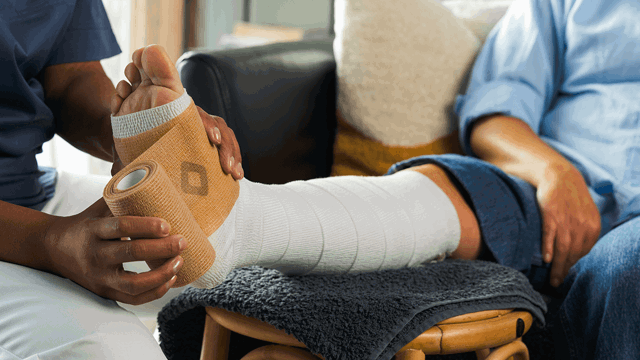
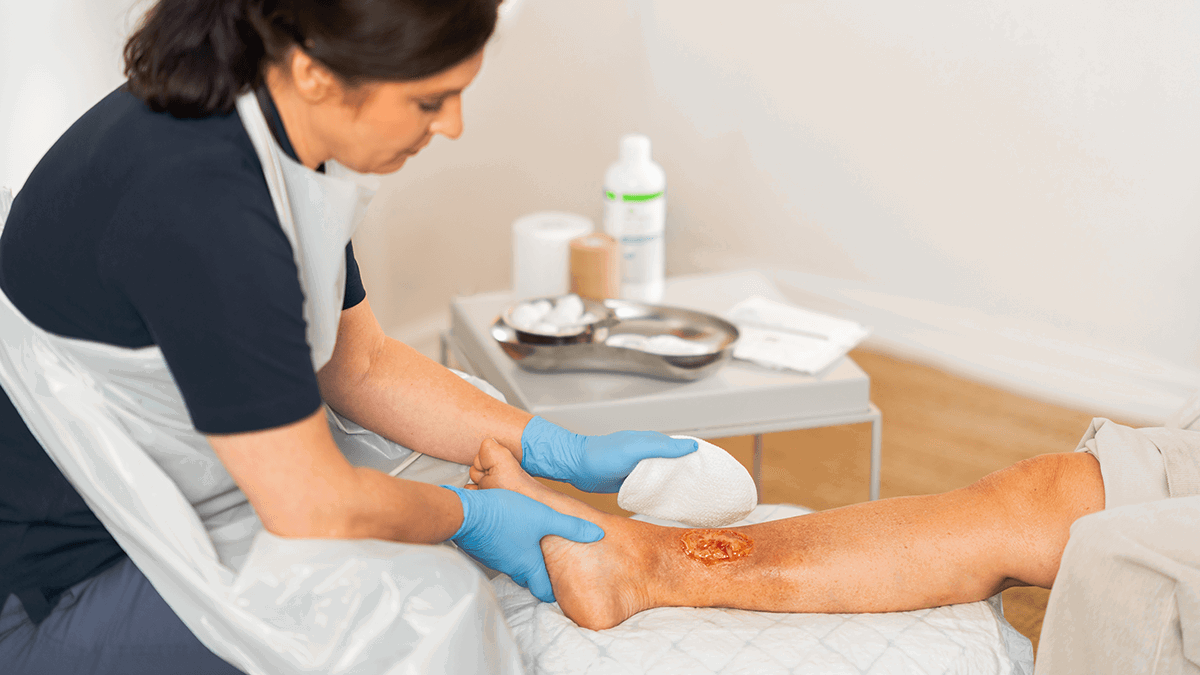
A photo of a nurse tending to the wound dressing on a leg.

Venous leg ulcer management guidelines and consensus recommendations

There are several guidelines and consensus recommendations for the management of VLU's1,2. A focus on compression therapy and exudate management is consistent in these guidelines & consensus recommendations3,4. A comprehensive assessment of the patient, the wound, and the surrounding skin should be made on initial presentation and at frequent intervals to guide ongoing management1,2,5.

Wound bed preparation and wound assessment

The management of chronic or hard-to-heal wounds relies on the holistic assessment of the person with a wound, using a framework that can help deliver optimal wound treatment.

M.O.I.S.T. is an educational model to help healthcare professionals feel confident in making well-balanced, independent decisions in the topical treatment of chronic wounds. This encourages a systematic approach to wound assessment. 

The M.O.I.S.T. concept provides healthcare professionals with guidance for systematic planning and education with regard to local therapy6.

  • Moisture Balance
  • Oxygen Balance
  • Infection Control
  • Support
  • Tissue

Risk of infection

Chronic non-healing wounds of the lower extremities are susceptible to infection, which can lead to serious complications, such as delayed healing, cellulitis, enlargement of wound size, debilitating pain, and deeper wound infections causing systemic illness7,8.

Compression therapy and wound debridement can encourage clearing of the infection and help promote healing9. Antimicrobial dressings may be used in the short term for the treatment of wound infection10. There is no evidence to support the routine use of systemic antibiotics to promote healing in a VLU7,10.

Exudate management in venous leg ulcers

Patients with a VLU generally have an increase in wound exudate when compared with patients with other forms of chronic skin ulcers8. Poor management of wound exudate can have a negative effect on patient quality of life and is associated with damage to the wound bed and periwound region, increased risk of infection, delayed wound healing, and increased costs to health services8.

Appropriate dressing selection and use in combination with the appropriate and sustained compression therapy work in conjunction to reduce excessive exudate levels2.

Compression therapy

Compression therapy is widely recognised as key to the management of a VLU. Compression therapy increases healing rates in comparison with no compression therapy11, and after healing, reduces recurrence rates12.

A variety of devices are used for compression therapy, including different types of bandages, bandage systems, and garments that provide sustained compression, and pneumatic devices that can apply intermittent compression7.

It is essential that the underlying aetiology is established, and arterial disease is excluded before treating a lower leg ulcer with compression therapy. This can be done through a combination of a holistic assessment and simple investigations. In 15-20% of VLU's, an arterial impairment coexists13, and these ulcers are known as ‘mixed ulcers’. Arterial impairment is assessed by measuring the ratio between the ankle and the brachial pressure using a test called the Ankle Brachial Pressure Index (ABPI).  In normal patients, a difference of 0.95 is not seen, however in arterial disease an ABPI of <0.8 would warrant further investigation before compression is applied14. Compression therapy must be avoided in severe, critical limb ischaemia7.

The role of dressings in the management of venous leg ulcers

Ulcers of the skin require wound dressings for protection from further trauma, management of wound fluid, and treatment. Because VLU's are associated with high levels of exudate that contain proteases and inflammatory cytokines that may damage surrounding healthy skin, current guidelines recommend the use of wound dressings that manage wound exudate while maintaining a moist wound bed7,13.

The effective management of wound exudate has been shown to reduce healing time and the risk of skin damage and infection.  Effective wound management also enhances a patients quality of life and improves healthcare clinical and cost efficiencies.

The dressing selected should be2:

  • effective under compression therapy, i.e. retain moisture without leaking when placed under pressure.
  • atraumatic without damaging the wound bed or periwound skin on removal.
  • comfortable and conformable to the wound bed.
  • of low allergy potential.
  • still intact on removal.
  • low profile (unlikely to leave an impression in the skin).
  • cost-effective, i.e., offer optimal wear time.

    1. Franks PJ, Barker J, Collier M, Gefen A, Haesler E, Javierre A, Laeuchli S, Mosti G, Probst S, Weller C. Management of patients with venous leg ulcers: challenges and current best practice. J Wound Care. 2016;25(6 Suppl):S1–67. doi: 10.12968/jowc.2016.25.Sup6.S1.
    2. Harding K, Dowsett C, Fias L, Jelnes R, Mosti G, Romanelli M, Oien R, Partsch H, Reeder S, Serena T, Vowden P, Weller C, Wensley S. Simplifying venous leg ulcer management: consensus recommendations [Internet]. Wounds Int. 2015. Available from:
      http://www.woundsinternational.com
    3. Wounds International. Principles of compression in venous disease: a practitioner’s guide to treatment and prevention of venous leg ulcers [Internet]. London (UK): Wounds International; 2013. Available from: https://www.woundsinternational.com/media/issues/672/files/content_10802.pdf
    4. World Union of Wound Healing Societies (WUWHS). Principles of best practice: compression in venous leg ulcers. A consensus document. London (UK): MEP Ltd; 2008.
    5. Australian Wound Management Association Inc. New Zealand Wound Care Society. Australian and New Zealand clinical practice guideline for prevention and management of venous leg ulcers [Internet]. Osborne Park (AU): Cambridge Publishing; 2011. Available from:
      https://www.awma.com.au/publications/2011_anz_guideline.pdf
    6. Dissemond J, Assenheimer B, Gerber V, Kurz P, Luchli S, Panfil EM, Richter D, Schilling M, Sticherling M, Topp T, Weichenthal M. Lokaltherapie chronischer Wunden: Das M.O.I.S.T. Konzept [M.O.I.S.T. concept for the local therapy of chronic wounds]. Dtsch Med Wochenschr. 2023 Mar;148(7):4005. German. doi:10.1055/a-1987-4999. PMID: 36940691. Available from: https://pubmed.ncbi.nlm.nih.gov/36940691/
    7. O'Donnell TF Jr, Passman MA, Marston WA, Ennis WJ, Dalsing MC, Kistner RL, Lurie F, Henke PK, Gloviczki ML, Eklöf BG, Stoughton J, Raju S, Shortell CK, Raffetto JD, Partsch H, Pounds LC, Cummings ME, Gillespie DL, McLafferty RB, Murad MH, Wakefield TW, Gloviczki P. Management of venous leg ulcers: Clinical practice guidelines of the Society for Vascular Surgery and the American Venous Forum. J Vasc Surg. 2014 Aug;60(2 Suppl):3S–59S. doi:10.1016/j.jvs.2014.04.0498. Romanelli M, Dini V, Rogers LC. Exudate management made easy. Wounds Int. 2010;1(2). Available from:
      https://www.woundsinternational.com/resources/details/exudate-management-made-easy
    8. Romanelli M, Dini V, Rogers LC. Exudate management made easy. Wounds Int. 2010;1(2). Available from: http://www.woundsinternational.com/made-easys/view/exudate-management-made-easy
    9. O’Meara S, Cullum N, Nelson EA. Compression for venous leg ulcers. BMJ. 2009;338:b2251. doi: 10.1136/bmj.b2251. Available from:
      https://www.ncbi.nlm.nih.gov/pmc/articles/PMC4202912/
    10. World Union of Wound Healing Societies (WUWHS). Principles of best practice: wound infection in clinical practice. An international consensus. London (UK): MEP Ltd; 2008.
    11. O’Meara S, Cullum N, Nelson EA. Compression for venous leg ulcers. Cochrane Database Syst Rev. 2012;(11):CD000265. doi:10.1002/14651858.CD0000265.pub3
    12. Nelson EA, Bell-Syer SE. Compression for preventing recurrence of venous ulcers. Cochrane Database Syst Rev. 2014;(9):CD002303. doi:10.1002/14651858.CD002303.pub4
    13. O'Donnell TF Jr, Lau J, Dolmatch B, Farber A, Eslami MH, MacKenzie KS, DePalma RG, Bandyk DF, Conte MS, Belkin M, Cambria RP. A systematic review of randomized controlled trials of wound dressings for chronic venous ulcer. J Vasc Surg. 2006 Nov;44(5):1118–25. Available from: http://www.jvascsurg.org/article/S0741-5214(06)01382-6/pdf01382-6/pdf)
    14. Feldgestein HS, Crull MG, Fronek A, Langer RD, Rejaard GA. Screening for peripheral arterial disease: the sensitivity, specificity, and predictive value of noninvasive tests in a defined population. Am J Epidemiol. 1991;134(5):526–34.

Select country

Get knowledge, learn about our products, get support and more.

Australia

No markets

Find jobs, our financial reports and more.

Mölnlycke corporate

Are you a healthcare professional?

This webpage contains information that is only intended for healthcare professionals. By selecting ‘Yes, I am’ you confirm that you are a healthcare professional.

No, I am not a healthcare professional