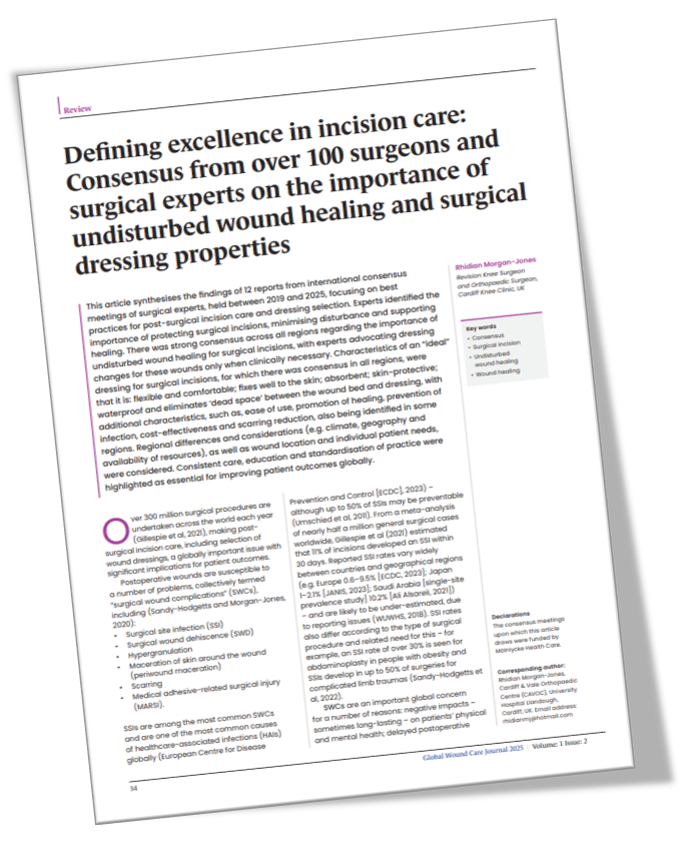
Protect your patients and your results

Post-op incision care has moved on, it's time to move with it.

The global modern views on incision care have been agreed upon by over 100 surgical experts from across Europe, Asia, the Middle East and Africa1

After 12 international consensus meetings between 2019 and 2025, they agreed on two essential principles:

  1. Post-operative dressings should only be changed when clinically necessary to reduce contamination, cost and promote healing.
  2. The ideal post-operative dressing should meet six key requirements for protection, comfort, and performance.

This consensus reflects a global commitment to progress. It sets out a clear standard, one that ensures surgical skill in theatre is carried forward into every patient’s recovery.

Access the full consensus document

Consent

We will handle any privacy data in accordance with our privacy policy 

(available under Policies). 

Your incision. Your decision

Your impact does not have to end with your last stitch. Your choice of post-surgical dressing and the standard of your incision care will determine whether your good work, and your patient’s recovery, are protected or undermined.

Upskill your wound care knowledge

  • In this training video, surgical oncologist Dr Sara Carvalhal (Joaquim Chaves Saúde, Portugal) shares her passion for incision care, emphasising the pivotal role of the surgeon.

    With a focus on primary closure and the factors that may increase the risk of complications, Dr Carvalhal outlines the characteristics of the ideal post-operative dressing and emphasises the benefits of undisturbed wound healing. She concludes with recommendations to support optimal outcomes.

    I want to be contacted by a Mölnlycke specialist


Look beyond unit price – consider total cost and impact on patient

  • When evaluating costs, looking at price per unit of dressing alone does not tell the full story. Conventional dressings often require repeated changes, increasing clinical workload and costs.1,2,3Advanced dressings, on the other hand, can stay in place for much longer, which not only promotes undisturbed wound healing but can also potentially reduce the total cost of incision care.

    I want to be contacted by an Mölnlycke specialist

Ready to elevate your incision care protocol?

Let us support you. 

Request a call from a Mölnlycke specialist

Consent

We will handle any privacy data in accordance with our privacy policy 

(available under Policies). 

References

    1. Hopper GP, Deakin AH, Crane EO, Clarke JV. Enhancing patient recovery following lower limb arthroplasty with a modern wound dressing: a prospective, comparative audit. J Wound Care. 2012;21(4):200–3.

    2. Bredow J, Hoffmann K, Oppermann J, Hellmich M, Eysel P, Zarghooni K. Evaluation of absorbent versus conventional wound dressing: a randomized controlled study in orthopedic surgery. Dtsch Arztebl Int. 2018;115(13):213–9.

    3. Zarghooni K, Bredow J, Siewe J, Deutloff N, Meyer HS, Lohmann C. Is the use of modern versus conventional wound dressings warranted after primary knee and hip arthroplasty? Results of a prospective comparative study. Acta Orthop Belg. 2015;81(4):768–75.

    4. Pickering D, Marsden J. Techniques for aseptic dressing and procedures. Community Eye Health J. 2015;28(89):17.

Select country

Get knowledge, learn about our products, get support and more.

Australia

No markets

Find jobs, our financial reports and more.

Mölnlycke corporate