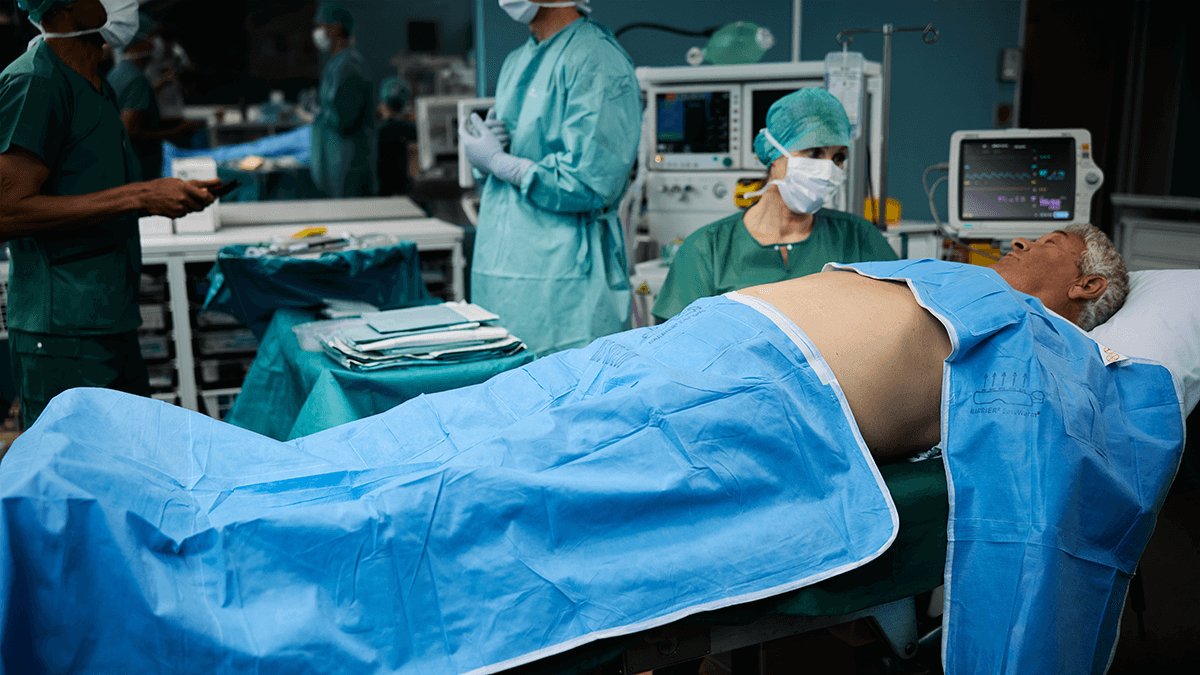
Even with active intraoperative warming, the initial drop in patients’ core body temperature typically happens in the first hour of surgery. Active Patient pre-warming contributes to prevention of the temperature drop and helps reduce the risk of hypothermic consequences.
Perioperative hypothermia is a common but dangerous side effect of undergoing anaesthesia, and it can have negative effects, such as poorer clinical outcomes and associated costs. Intraoperative perioperative hypothermia (IPH) is an established risk factor for developing surgical site infections (SSIs). The clinical guidance on the management of IPH in adults reports that hypothermic patients have a four-times-higher risk of developing SSIs compared to normothermic patients2.
Risks of perioperative hypothermia
General anaesthesia is just one of the multiple aspects of surgery that impacts patients’ core body temperature, which can lead to hypothermia. Studies have shown that perioperative hypothermia can have significant negative impacts on patients, including impairing coagulation, drug metabolisation, and a three-fold increased risk of surgical wound infections3.
Other potential complications of perioperative hypothermia
Patients can also experience other complications including additional blood loss and increased pain scores as a result4. Furthermore, hypothermia delays wound healing and has been shown to prolong the patient’s length of stay in hospital by 20% – even in patients who do not suffer an infection, leading to hospital stays that are on average two days longer than necessary4. Therefore, not only is avoiding hypothermia critical to improving patient safety and infection prevention; it is also critical to ensuring efficient use of hospital resources. Any clinical measures that can be taken to reduce length of hospital stays and rates of surgical site infections will help to ease the current elective care backlog facing the health system.
Prevent the temperature drop
There are strategies for stopping the anaesthesia-induced core body temperature drop. With patient pre-warming, you can actively protect against it.
Prevention: Monitor temperature and keep patients warm
To ensure that patients do not become hypothermic, monitor their core body temperature regularly and keep them warm before, during and after surgery.
The importance of pre-warming patients
Considering the risks of perioperative hypothermia, it is vital that a patient’s body temperature is kept within normothermic thresholds throughout the entire surgical process. Active pre-warming is an evidence-based intervention that can be easily implemented across the surgical pathway to reduce these risks.
Public health organisations have been clear on the importance of active patient pre-warming. For instance, NICE recommends active warming preoperatively if a patient’s temperature is below 36°C5. Similarly, the 2019 GIRFT Surgical Site Infection National Survey presented a case study in Ashford and St Peter’s Hospitals NHS Foundation Trust, where it was shown that pre-warming with an EasyWarm blanket reduced perioperative hypothermia rates in a group of 422 patients from 44% to 3%6. Devices to keep the patient warm are therefore an integral element of the surgical patient journey to promote efficient warming, which not only greatly reduces health risks, but is also endorsed by regulatory bodies.
Understand who benefits from pre-warming
Pre-warming offers benefits to every surgical patient. Hypothermia can affect any patient of any age having any procedure. However, certain groups are at a greater risk of hypothermia and stand to benefit the most from patient pre-warming practice:
- The very young and the very old7
- Patients with medical conditions that affect thermoregulation, such as stroke, Parkinson’s disease, spinal cord injuries or burns8
- Trauma patients8
Pre-warming is key to prevention
Active patient pre-warming plays an important role in stopping redistribution hypothermia by reducing the initial drop in core body temperature. It can also add to patient comfort and reduce patient anxiety throughout the entire procedure.
But how is pre-warming done?
Patient pre-warming for the full perioperative journey
Applying pre-anaesthetic skin-surface warming helps patients maintain normothermia by slowing the typical 1.0-1.5°C temperature drop.
While many warming devices exist, active, self-warming blanket solutions offer a way to stop the temperature drop before surgery begins. Keeping patients warm and comfortable, single-use, self-warming blankets provide protection and comfort.
-
Designed to follow the patient throughout the entire surgical journey – from the pre-surgical stage through post-op recovery, the EasyWarm® self-warming blanket is a versatile solution that can easily be implemented into the surgical patient pathway in any hospital. The EasyWarm self-warming blanket provides a convenient patient-warming solution that can be used by perioperative teams before, during and after surgery to counteract the risk of patient hypothermia. With its active self-warming technology, it does not require an external power source, meaning it can be easily deployed; and can stay with the patient after surgery to reduce postoperative shivering.
EasyWarm is a conductive warming device, which NICE has highlighted in its latest guidance as less likely to cause surgical site infections than forced-air warming (FAW) devices which are more likely to disrupt the air flow around surgical sites5. A 2019 study found that EasyWarm self-heating blankets offer a near identical performance in heating patients compared to a forced-air warming (FAW) blanket Cocoon, while having major advantages, such as reducing clutter in the operating theatre and trip hazards due to the absence of electrical or other cords9. EasyWarm’s technology avoids possible complications, as it does not use forced air-warming, while offering an easily integrated solution to the existing patient journey.
EasyWarm: Practical details
With many patient warming solutions, there are practicality questions – are they safe? Do they require electricity? At which stage in the perioperative journey can it be used? As described, EasyWarm offers all its clinical benefits alongside convenience, ease of use and safety.
Easy, safe, immediate warmth
The EasyWarm blanket is practical, easy to use and suitable for the entire patient journey. It reaches operational temperature within 30 minutes of activation and maintains this temperature level for up to ten hours, making it ideal for reducing the initial drop in core body temperature prior to and during surgery, and a useful post-operative solution for keeping patients warm and comfortable.
EasyWarm setup
Setting up the EasyWarm® or EasyWarm+ blanket is quick and easy9, 10. Simply open the vacuum packaging and unfold the blanket. No additional equipment is necessary. The blanket begins warming immediately once removed from packaging.
Learn more about how to set up and use EasyWarm.
-
BARRIER EasyWarm Instructions
-
BARRIER EasyWarm Quick Guide
When and how EasyWarm can be used
EasyWarm has been designed for use before, during and after surgery. It helps prevent the initial temperature drop and keep patients comfortable as well as impede the onset of intraoperative hypothermia. Because there is no need for additional equipment and portable, EasyWarm can easily be made available for more patients6, 7 – and patients can keep their blanket throughout the perioperative period to maintain warmth throughout. It’s also noiseless because it doesn’t require additional equipment, electricity or anything more than the blanket itself7.
How does EasyWarm work?
Heat from the single-use self-warming EasyWarm blanket is generated by an exothermic chemical reaction that happens when the blanket is unfolded and exposed to air, resulting from the oxidation of iron. The warmers in the blanket are all-natural: activated carbon, iron, water, salt, clay and chemicals. These warming pads are all securely contained within the blanket in 12 separate pockets. The pockets are designed and positioned to provide the maximum heat transfer in the most efficient manner to reach operational temperature optimally and distribute heat evenly to the patient.