Pressure injury severity is assessed using the international NPIAP/EPUAP/PPPIA classification system. This requires the clinician to determine the depth of the injury by visual inspection of the wound, and in the case of a Stage 1 injury, to identify the presence or absence of non-blanching erythema. In most cases a pressure injury will develop over a bony prominence such as the heel or the sacrum (most common sites for pressure injuries), however pressure injuries can also occur in areas of adipose fat and mucosal tissue, particularly in device-related pressure injury. Following initial staging of the pressure injury, the clinician needs to ascertain the history of the wound in terms of how and when it was developed and the patient’s understanding of the wound and its causation. Note should be made of the degree of pain experienced by the patient related to the wound as well as any systemic signs of infection.
Staging
Stage 1 - Non-blanchable erythema
May be painful, firm, soft, warmer or cooler as compared to adjacent tissue. In darkly pigmented skin, non-blanchable erythema may be difficult to detect, therefore, close attention to skin changes is paramount.
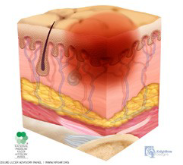
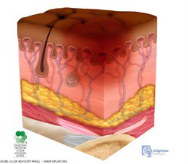
Stage 2 - Partial-thickness skin loss
Presenting as a shallow open wound with a red pink wound bed, without slough. May also present as an intact or open/ruptured serum-filled blister.
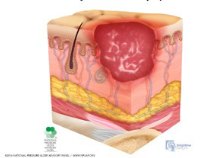
Stage 3 - Full-thickness skin loss
Subcutaneous fat may be visible but bone, tendon or muscle are not exposed. Slough may be present but does not obscure the depth of tissue loss. May include undermining and tunnelling.
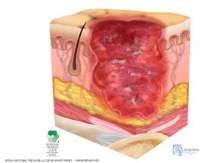
Stage 4 - Full-thickness tissue loss
Exposed bone, tendon or muscle. Slough or eschar may be present on some parts of the wound bed. Often includes undermining and tunnelling.
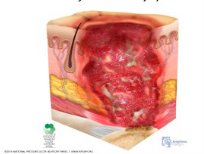
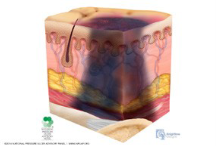
Suspected deep tissue injury
Depth unknown. Purple or maroon localised area of discoloured intact skin or blood-filled blister due to damage to underlying soft tissue from pressure and/or shear and friction. The area may be preceded by tissue that is painful, firm, mushy, boggy, warmer or cooler as compared to adjacent tissue.
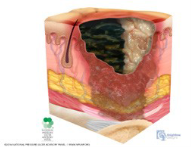
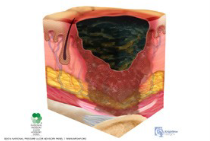
Unstageable
Depth unknown. Full-thickness tissue loss in which the base of the wound is covered by slough (yellow, tan, gray, green or brown) and/or eschar (tan, brown or black) in the wound bed.
Assessment for all stages
Location - Document anatomical location of PI
Tissue Type - Determine the characteristics of the wound bed, noting the visible tissue which may include pink epithelial tissue, red granulation tissue, yellow slough, black necrotic tissue
Exudate - Determine the type, amount and nature of wound exudate which may include, serous, serosanguinous, purulent and/or viscous fluid
Odour - Note the presence of malodour from the wound
Wound Edge - Observe for undermining of the wound edges or any tunnelling which may be present
Peri-wound - Describe the condition of the skin surrounding the wound and observe for maceration and inflammation
Infection - Assess for overt signs of wound infection
Document findings in individuals electronic medical record (EMR).
* National Pressure Ulcer Advisory Panel, European Pressure Ulcer Advisory Panel and Pan Pacific Pressure Injury Alliance. Prevention and Treatment of Pressure Ulcers: Clinical Practice Guideline. Emily Haesler (Ed.). Cambridge Media: Osborne Park, Western Australia; 2014.