Jamie Smith
Media Relations
Email: jamie.smith@molnlycke.com
Phone: +46 723 757507
Gothenburg, Sweden. 27 April 2026. A new study1 published in the Journal of Hospital Infection shows that introducing a simple glove change during caesarean birth could deliver millions in cost savings for the National Health Service (NHS) in England.

Clinical evidence shows that changing surgical gloves after placental delivery and before final abdominal closure can reduce surgical site infection (SSI) risk by 59%². A research team, led by Benedict Stanberry, Principal at the Institute of Healthcare Leadership and Management in Oxford, analysed this data, alongside cost data from NHS England and maternity service data from the Royal United Hospitals Bath NHS Foundation Trust (RUHB) to model the potential financial impact of making routine glove-changing part of caesarean care. The analysis was commissioned by Mölnlycke®, reflecting the company’s commitment to advancing safer, more sustainable healthcare.
The study found that implementing the glove change could deliver £339,654 in cost savings over a five-year period at RUHB alone. Most of these savings, £254,507, would come from fewer community midwife post-natal visits and reduced hospital readmissions, while local GP practices would see an estimated £85,147 reduction in costs linked to infection-related appointments.
Importantly, when the findings were extrapolated across England, the analysis showed that glove‑changing before wound closure could reduce the national economic burden of post‑caesarean SSIs by £45.1 million over five years1.
Furthermore, by reducing avoidable infections and the follow-up care they require, the glove change intervention could potentially help free up valuable clinical time and ease pressure on overstretched healthcare staff and services, supporting a more resilient and sustainable healthcare system.
The model also tested multiple scenarios to ensure the robustness of results across variations in caesarean volume, infection rates and length of hospital stay. In every scenario, the glove‑change intervention continued to produce substantial cost savings.
“Existing clinical research shows that changing gloves after placental delivery, before final closure, reduces surgical site infection rates. Our analysis of this simple change in practice can reduce costs and release capacity for NHS maternity services by reducing hospital readmissions and community follow-up. It is an effective way to reduce spending and utilise resources more efficiently while also improving maternal outcomes,” says Benedict Stanberry, Principal Investigator.
According to the World Health Organization (WHO), caesarean section rates continue to rise worldwide, now accounting for 21% of all births and projected to reach 29% by 2030. In England, the increase has been particularly pronounced, with caesarean births rising from 29.7% in 2018 to 41.4% in 20244.
“With more women undergoing major surgery, the risk of complications is rising. Cesarean sections carry some of the highest rates of surgical site infection. This study shows that something as simple as changing gloves before wound closure can make a real difference for mothers and maternity care services. Our Biogel® gloves are designed to make that best practice easy and seamless, so clinicians can stay focused on what matters most: caring for patients,” says Monika Petty, Marketing Manager Gloves at Mölnlycke Health Care.
This research was commissioned by Mölnlycke as part of the company’s commitment to advancing safer, more sustainable care. Reducing surgical site infections lowers the need for additional treatment5; saving resources and cutting emissions5, 6.
Mölnlycke supports clinicians in adopting best practice through Biogel® surgical gloves, which enable quick, safe glove changes without disrupting workflow.
Mölnlycke experts work with NHS maternity care teams to provide training, guidance and practical tools for seamless implementation. With Biogel®, surgical teams can simply change the overglove, while the intact underglove remains in place; delivering both protection and efficiency.
Find out more about how Mölnlycke can support maternity teams in adopting best practice: www.molnlycke.com/en-gb/glove-change
Related links: https://www.journalofhospitalinfection.com/article/S0195-6701(25)00354-8/fulltext
For more information, please contact:

Media Relations
Email: jamie.smith@molnlycke.com
Phone: +46 723 757507

Mölnlycke has joined the American Limb Preservation Society (ALPS) as an official Gold Strategic Partner, reinforcing a shared commitment to improving outcomes for patients at risk of amputation due to diabetic foot complications.

At Mölnlycke Health Care, we work alongside clinicians, researchers and healthcare experts to advance evidence-based care and help raise standards for post-operative care.

Gothenburg, Sweden. 21 September 2026. Mölnlycke Health Care (Mölnlycke®), a global leader in MedTech, today announces the launch of The Hidden Capacity Report, a new international report revealing significant opportunities to expand day surgery and help healthcare systems improve efficiency, increase surgical throughput and enhance patient outcomes.
Gothenburg, Sweden. 16 September 2026. Mölnlycke®, a global leader in MedTech, announces its intention to separate its Operating Room Solutions (ORS) and Gloves businesses into a new standalone company (referred to here as “Mölnlycke Surgical”). The separation is intended to create conditions for both Mölnlycke and Mölnlycke Surgical to reach their full potential and drive value creation long-term.

UK’s Largest Hip and Knee Replacement Centre Becomes First in Scotland to Adopt Steriwave® Nasal Photodisinfection.

Gothenburg, Sweden. 23 June 2026. Mölnlycke Health Care (Mölnlycke®), a global leader in MedTech, today announces changes to its Board of Directors. Christian Cederholm will leave his Board assignment, while Filippa Stenberg will take his place as member of the Board. Thomas Kidane will step in as deputy board member.

Gothenburg, Sweden. 8 June 2026. Mölnlycke Health Care (“Mölnlycke®”), a global leader in MedTech, today confirmed a combined investment of approximately EUR 40 million in Mikkeli, Finland, and Oldham, UK. The investments strengthen the company’s global wound care manufacturing network by increasing capacity, optimising process quality and enhancing supply chain resilience and sustainability.
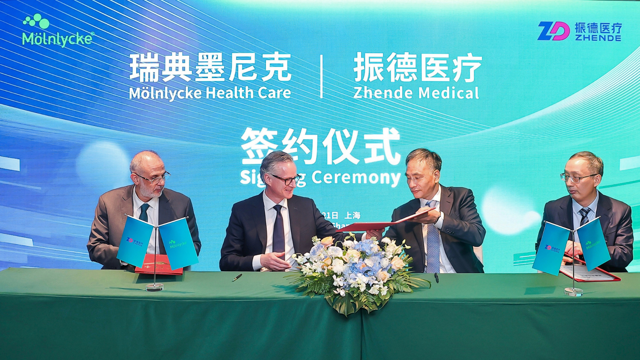
Gothenburg, Sweden, and Shanghai, China. 21 May 2026.
Mölnlycke Health Care (“Mölnlycke®”), a global leader in MedTech and advanced wound care solutions, and Zhende Medical, a leading supplier of medical care and protection in China, today announce the formation of a new joint venture company in China to accelerate growth in one of the world’s fastest-growing wound care markets. The joint venture, majority-owned by Mölnlycke, will integrate the two companies’ wound care portfolios and commercial capabilities to offer healthcare providers, patients and the public expanded access to advanced treatments, improved care delivery and better patient outcomes across China.

Gothenburg, Sweden. Wednesday 15 April 2026. Mölnlycke Health Care announces today the appointment of Andreas Johansson as Interim Chief Financial Officer (CFO), with immediate effect.