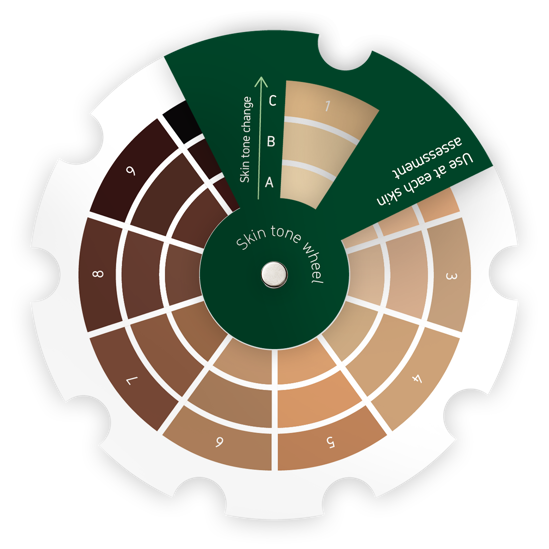
Identifying and documenting changes in skin tone is essential in wound care, yet research shows that around 87% of healthcare professionals do not routinely record skin tone during wound assessment1. This is particularly significant for patients with darker skin tones, where early signs of infection or pressure damage can be easier missed due to a lack of tools to recognise them, which can lead to late diagnosis and delayed treatment.
One of the keys to more accurate, complete wound assessment relies on a thorough inspection of the patient’s skin, which demands as a first step the ability to identify a baseline patient skin tone and to document any changes early on2. Without early detection of skin tone changes, important signs indicating preventable skin and tissue breakdown can be missed.
As highlighted in the Wound Care and Skin Tone International Consensus document, published in 2023, accurate and timely patient assessment forms the foundation of all care, and correct and effective treatment (or prevention) is not possible until a thorough assessment is carried out3.
The consensus document also highlighted several important gaps in delivering equitable care in wound assessment:
- Lack of clear guidance on accurate assessment and diagnosis in all skin tones
- Lack of consistent, unbiased, and inclusive language and descriptors for skin tones
- Lack of education to improve clinician confidence
These gaps are critical to address, as conditions such as pressure ulcers may present differently in patients with darker skin tones. Diagnosis is key to outcomes, and a practical reference tool can play a vital role in bridging knowledge gaps and reducing health inequalities in wound management.
Delivering equitable care: Moving beyond the challenges of skin tone assessment
Historically, wound care education and clinical imagery have been biased toward lighter skin tones2. This has contributed to disparities in how quickly and accurately conditions like pressure ulcers, infections, or tissue damage are identified across diverse skin tones.
One of the barriers to unbiased approaches has been a lack of a clear, shared understanding of how to assess skin tones changes for diagnostic purposes.
Developed in collaboration with clinical experts
Mölnlycke is committed to promoting inclusive, evidence-based care. That’s why we are introducing the Skin Tone I.D.TM — a practical tool designed to support healthcare professionals in assessing, comparing, and documenting skin tone changes across diverse skin types. It extends the work outlined in the consensus document (adapted from the colour bar tool Ho and Robinson, 2015)2 promoting a consistent documentation of skin tone changes across gradients beyond just “light” and “dark” with a visual reference for all skin tone types. To enables clinicians to select the skin tone that most closely matches their patient’s skin tone.
The Skin Tone I.D. was developed in close collaboration with Luxmi Dhoonmoon, Consultant tissue viability nurse in the UK. The goal was to create a validated, and easy-to-use tool to help ensure consistent documentation of skin tone changes, and support timely skin assessment for every patient, regardless of their skin tone.
How the Skin Tone I.D. TM by Mölnlycke works4
The Skin Tone I.D. TM provides a structured way to assess and record skin tone at different stages of wound care.
- Identify a baseline skin tone
Begin by selecting an unaffected area of skin. Place the wheel next to the patient’s skin and match it to the closest tone on the wheel (for example, 9B). Document this tone as the patient’s baseline. - Assess the affected area
Next, compare the skin in the affected area against the baseline tone. Note any differences, for instance, if 9B has become 9C, and document the findings in the patient’s notes. - Monitor for changes over time
Reassess at every dressing change or wound review. A darker, lighter, or otherwise altered tone may indicate changes in perfusion, infection, or inflammation.
In addition to colour, assess the temperature, texture, and sensation of the skin: is it warmer, cooler, spongy, firm, painful, or itchy? These combined observations can help identify complications early and prompt timely intervention.